7.2.1
Activity Name: Electricity Efficiency Improvement Program for Government Agencies and Schools
活動名稱 「政府機關及學校用電效率提升計畫」
Summary
In response to global climate change and the transition to net-zero emissions, the Executive Yuan announced Taiwan's Pathway to Net-Zero Emissions in 2050 and its accompanying strategies on March 30, 2022. The pathway comprises four transitions—energy, industry, lifestyles, and society—supported by two governance foundations, technology research and development and climate legislation, and 12 key strategies. Action plans target important areas of expected growth in energy, industrial, and lifestyle transformation policies to achieve the net-zero transition.
The Energy Saving Key Strategy Action Plan, approved by the Executive Yuan in April 2023, promotes systematic electricity conservation, monitoring and evaluation by organizational unit, smart management, and equipment efficiency improvements. To address organizational restructuring of the Executive Yuan and changes in electricity use associated with the policy of installing air conditioning in every elementary and junior high school classroom, the Electricity Efficiency Improvement Program for Government Agencies and Schools was established for 2024–2026. Based on the principle of improving electricity efficiency by 1% annually, the current phase targets a 3% overall improvement by 2026 compared with 2023. Targets will be reviewed and adjusted according to implementation results and developments in electricity-saving technologies. The gap between each agency's or school's baseline electricity-use indicator and the program's published benchmark is converted into a required saving, with annual targets assigned to individual institutions for 2024–2026.
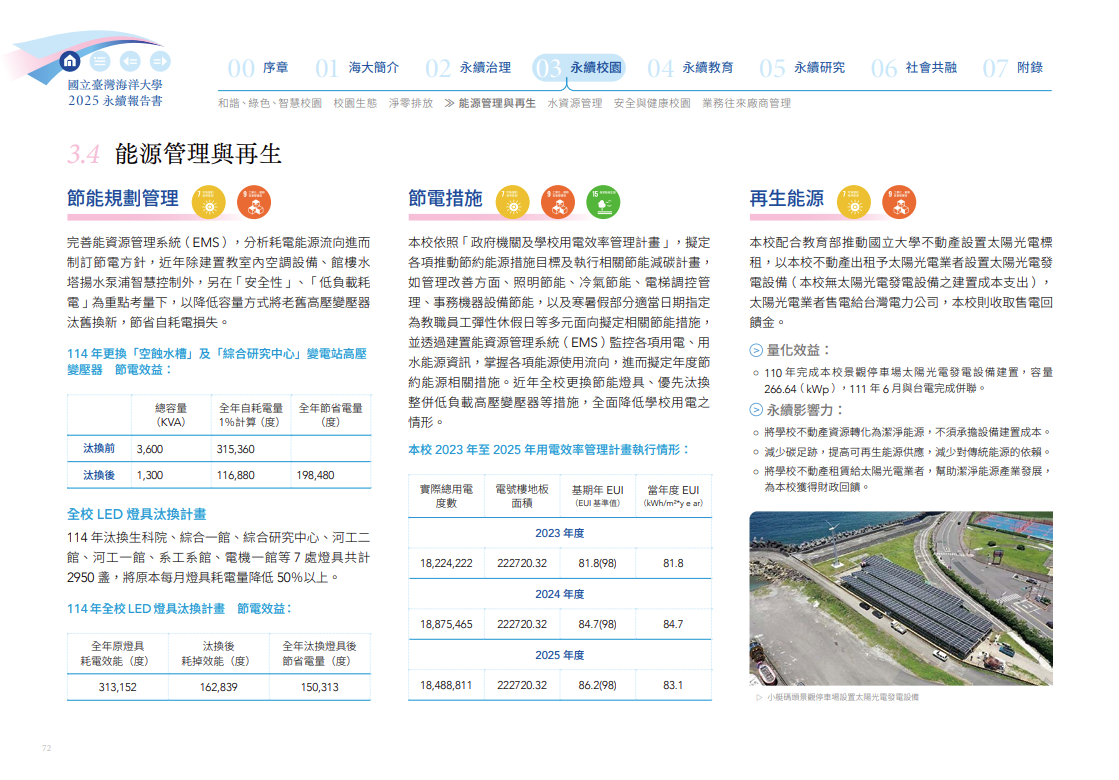
In 2025, the University replaced 2,950 lighting fixtures at seven locations, reducing their monthly electricity consumption by more than 50%. It also replaced high-voltage transformers at the cavitation tunnel and the General Research Center substation. Annual transformer self-consumption fell from 315,360 kWh to 116,880 kWh, a reduction of approximately 62%.
摘要
因應全球氣候變遷及淨零排放趨勢,行政院於111年3 月30日公布我國「2050淨零排放路徑及策略總說明」,以 「能源轉型」、「產業轉型」、「生活轉型」、「社會轉 型」等四大轉型,及「科技研發」、「氣候法制」兩大治 理基礎,輔以「十二項關鍵戰略」,就能源、產業、生活 轉型政策預期增長的重要領域制定行動計畫,落實淨零轉型目標。
行政院於112 年 4 月核定之「節能關鍵戰略行動計畫」, 以系統化節電,單位化管考、智慧化管理、設備效率提升 等推動作法,配合行政院組織改造以及國民中小學「班班 有冷氣政策」之用電行為改變,爰訂定「政府機關及學校 用電效率提升計畫」(113年至115年),以用電效率每年提升1%為原則,本期訂定目標為115年整體 用電效率較112年提升 3%,未來依執行成效及節電技術發 展情形滾動檢討節電目標,並以各機關及學校基期用電指標與本計畫公告基準 之差距換算為節電目標量,賦予個別機關學校於 113年 至115年間分年應達成之節電目標。
114年間,本校汰換7處共2950盞燈具,將原本每月燈具耗電量降低50%以上。並更換空蝕水槽及綜合研究中心變電站高壓變壓器,全年自耗電由315,360度降至116,880度,減少約62%。
Sustainability Impact
Electricity consumption fell from 315,360 kWh to 116,880 kWh, a total reduction of 198,480 kWh and a saving of 62.94%, demonstrating substantial improvements in energy efficiency and results in energy conservation and carbon reduction.
永續影響力
用電量由315,360度降至116,880度,總計減少198,480度,節電率達62.94%,展現顯著的能源使用效率改善及節能減碳成效。
Evidence: https://www.moeaea.gov.tw/ECW/populace/content/Content.aspx?menu_id=2802&sub_menu_id=5737
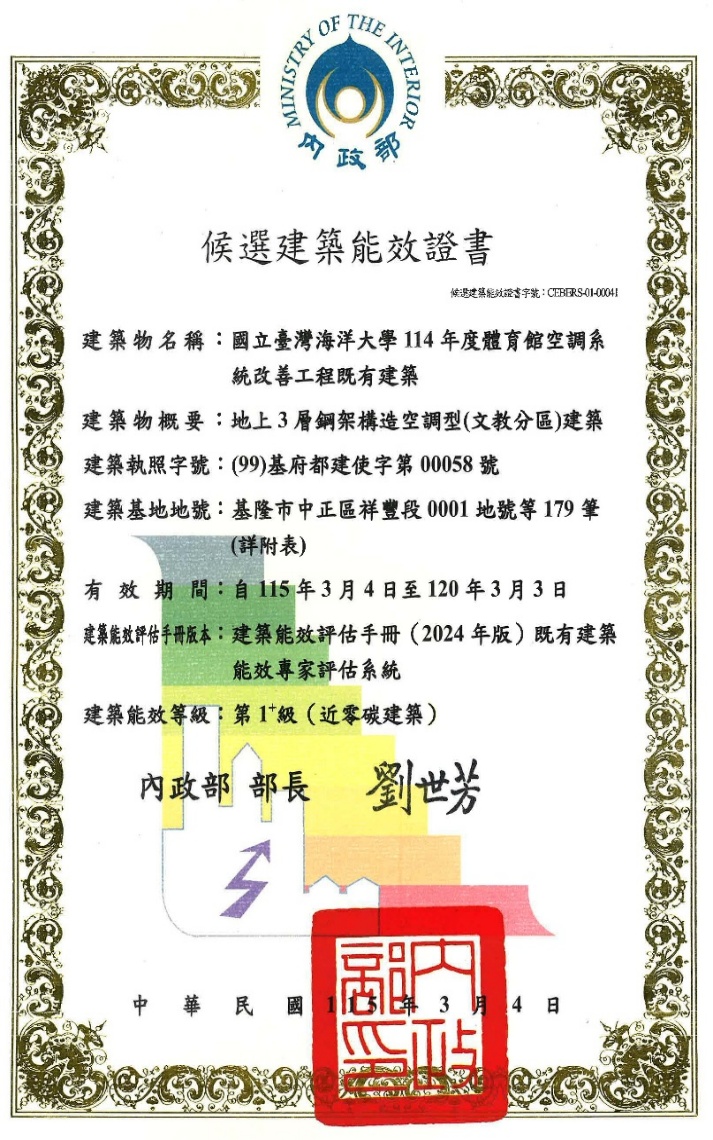
Activity Name: 2025 Air Conditioning System Improvement Project for NTOU's Existing Gymnasium Building
活動名稱 國立臺灣海洋大學114年度體育館空調系統改善工程既有建築
Summary
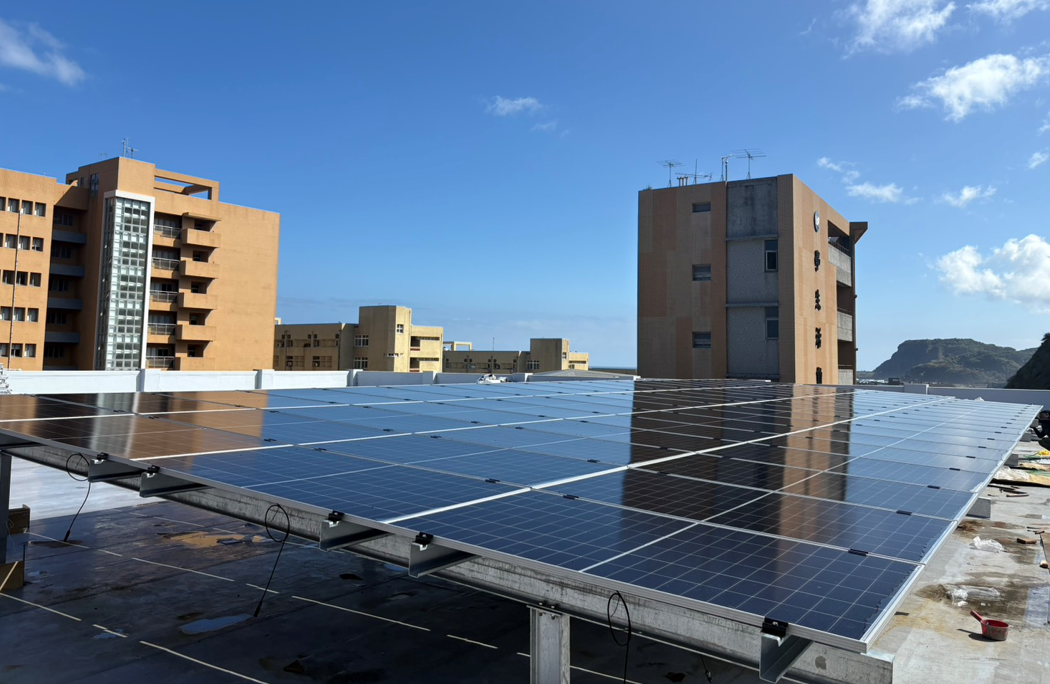
The gymnasium installed renewable energy and energy storage systems, combining rooftop solar power for on-site generation and consumption with an outdoor energy storage system to create a disaster-resilient microgrid. Fully automatic switching between grid-connected and islanded operation enables smart energy management and resilient operation. Energy-efficient equipment replacements and a building energy management system (BEMS) also improved the gymnasium's energy use intensity (EUI) by 42%. The building received a Grade 1+ energy efficiency label for existing buildings, becoming a model of a nearly zero-carbon building aligned with the 2050 net-zero pathway and contributing to a sustainable and resilient campus.
摘要
體育館建置再生能源及儲能系統,透過屋頂光電自發自用,以及戶外儲能設備供電,打造「防災型微電網」,藉由「併網/孤島」雙模式全自動運轉切換,實現智慧能源與韌性運轉。另透過節能設備汰換並導入建築能源管理系統(BEMS),將體育館建築能效指標EUI大幅改善42%,取得既有建築能效標示1+級,成功打造符合2050淨零路徑的「近零碳建築」標竿領域,逐步實現永續韌性校園之目的。
Sustainability Impact
The gymnasium improved its energy use intensity (EUI) by 42% and received a Grade 1+ energy efficiency label for existing buildings. It has become a model of a nearly zero-carbon building aligned with the 2050 net-zero pathway, advancing the goal of a sustainable and resilient campus.
永續影響力
將體育館建築能效指標EUI大幅改善42%,取得既有建築能效標示1+級,成功打造符合2050淨零路徑的「近零碳建築」標竿領域,逐步實現永續韌性校園之目的。
Evidence: https://peadmin.ntou.edu.tw/p/406-1012-117878,r368.php?Lang=zh-tw